This week, I thought I would write something slightly different and focus more on investing. More specifically, I want to make the case for why agricultural land could be one of the more overlooked investment opportunities, especially land with higher yields and greater potential in emerging markets.
There are several straightforward reasons why agricultural land strikes me as both an economic pressure point and an investment opportunity. The most obvious mechanism is population growth. A growing global population naturally translates into greater demand for food, but the scale of that growth is worth considering. The United Nations projects that the world population will reach 9.6 billion by 2050, an increase of approximately 1.4 billion people from 2024. Equally important is the changing composition of food demand. As incomes rise, particularly across emerging economies, diets are likely to become more varied, with consumption of meat and dairy products likely to increase. This will place further demands on agricultural production. The OECD and FAO forecast that the value of global agricultural and fish commodity consumption will increase by 12.5% over the coming decade, with India and Southeast Asia alone accounting for approximately 39% of that growth.
The supply side is where things get more complicated. Despite these demand projections, the world's supply of productive agricultural land remains relatively constrained. FAO data show that approximately 1.6 billion hectares were classified as cropland in 2023. What is more concerning is the condition of land already being used. The FAO estimates that human activity has degraded more than 1.6 billion hectares of land, with agricultural areas accounting for roughly 60% of that degradation. Soil erosion, declining fertility and poor land management will gradually reduce productive capacity, making it more expensive to maintain existing yields, let alone increase them, if intervention does not take place soon.
Climate change adds another layer of uncertainty. Interestingly, I read a Financial Times piece by Pilita Clark this week exploring why men tend to express less concern about climate change than women, and how framing environmental action around financial benefits could change people's attitudes. It struck me because agriculture offers a tangible example of the economic consequences of a changing climate, regardless of how people might perceive the wider debate. Take this summer in the UK, which the Met Office recorded as provisionally the hottest on record. The consequences were visible in the harvest. According to the Agriculture and Horticulture Development Board, surveyed winter wheat yields were approximately 11% below the national five-year average, while spring barley yields were 17% lower following unusually dry growing conditions. The picture was similar across parts of Europe, where the European Commission's Joint Research Centre projected soybean yields to be 15% below their five-year average and grain maize yields to be 8% lower. Not every crop suffered equally, but the wider point is the same: extreme weather is becoming an increasingly important economic risk for agricultural production, making reliable access to water and resilient farmland more valuable.
Wider pressure comes from something less immediately associated with farmland: energy markets. This is a connection I explored in a previous article. Modern agriculture is heavily dependent on fertilisers, particularly products manufactured using natural gas. As I discussed in Commodity Behind the Commodity: Sulphur, sulphur, much of which is recovered through oil refining and natural gas processing, is also essential for producing phosphate fertilisers. This means that agricultural production is exposed to disruptions in energy infrastructure, with consequences extending beyond energy prices and into the cost of essential farming inputs. The conflict in the Middle East has demonstrated this vulnerability, with interruptions to production and shipping through the Strait of Hormuz tightening fertiliser supplies. In April, the World Bank projected a 31% increase in fertiliser prices during 2026, driven partly by an anticipated 60% rise in urea prices. Higher costs squeeze farmers' margins and can lead to reduced fertiliser application, potentially affecting yields in subsequent harvests. Alternative suppliers may help, but shifting supply chains takes time and can introduce further transport costs.
The problem facing agriculture now is not just to produce more food. It is to do so with increasingly constrained resources and greater exposure to external shocks, whether from conflict or extreme weather.
Of course, this does not mean agricultural land will magically appreciate in value. Advances in technology, irrigation and crop management have allowed production to increase without requiring more cultivated land. For example, a study of farmers in Zambia found that adopting drought-tolerant maize varieties increased yields by 38% and reduced the risk of crop failure by 36%. These improvements can help farmers produce more from the same area while reducing their exposure to unfavourable weather. In fact, the FAO estimates that the value of global agricultural production per hectare increased by more than 60% between 2001 and 2023, despite cropland per person declining by approximately 20%. This makes me think about which existing land and countries have the greatest scope to become more productive, which is what draws me towards emerging markets.
Agricultural land is far from a uniform asset. Two similarly sized farms can have entirely different productive capacities depending on soil quality, water availability, machinery, infrastructure and access to markets. In many developed agricultural economies, decades of investment have already brought production relatively close to what existing technology and local conditions can support. Parts of the developing world, meanwhile, still have considerable room for improvement. The African Union has repeatedly highlighted the continent's substantial share of the world's uncultivated arable land. Not all of this land is economically accessible or environmentally suitable for cultivation, but it does show the scale of Africa's agricultural resources.
There is a term from my macroeconomics lectures that I think could help explain the opportunity: convergence. Broadly speaking, convergence describes the process through which less productive economies catch up with, or grow faster than, developed ones by adopting existing technology, accumulating capital and improving how resources are used.
Rather than having to invent entirely new methods of agricultural production, countries with low productivity may be able to make considerable improvements by using practices that are already established elsewhere. This is not guaranteed, though. Convergence depends on underlying conditions, including infrastructure, institutions and access to investment. It has also not been evidenced in Africa in the same way that it was in the Asian Tigers, which makes the idea difficult to generalise. Applied to agriculture, the potential gains from introducing reliable irrigation or mechanisation to a farm that has never had them may be much greater than the gains from making another incremental improvement to an already highly productive operation. At the same time, this process could significantly disrupt labour markets in countries where a large share of the workforce depends on agriculture.
The figures help illustrate just how substantial these differences can be. According to the World Bank, agriculture accounted for approximately 49% of employment in Sub-Saharan Africa in 2025, compared with around 3% in the European Union. Yet the World Bank also estimates that only 6% of farmland in Sub-Saharan Africa is irrigated. Much of the region remains heavily dependent on rainfall, leaving farmers exposed to seasonal uncertainty and limiting the crops they can reliably produce. Investment in irrigation, machinery, soil management and transport infrastructure could greatly improve productivity. Whether this would benefit local communities, however, is less clear. In some cases, it could also disrupt local labour markets.
There are examples of this process already taking place. In Tanzania, a World Bank-supported rural electrification programme helped a women's farming cooperative move towards year-round okra cultivation by making irrigation more reliable and affordable. Previously, inconsistent rainfall and the cost of running a generator had limited production. Access to grid electricity made it possible to irrigate more consistently and increase output.
Similarly, in Ethiopia, the World Bank documented a farmer increasing his maize harvest from nine to fifteen quintals, with one quintal equal to 100 kilograms, on the same quarter-hectare plot after adopting improved soil management and fertilisation. These are relatively small examples and cannot necessarily be replicated everywhere, but they demonstrate how existing agricultural land can become considerably more productive.
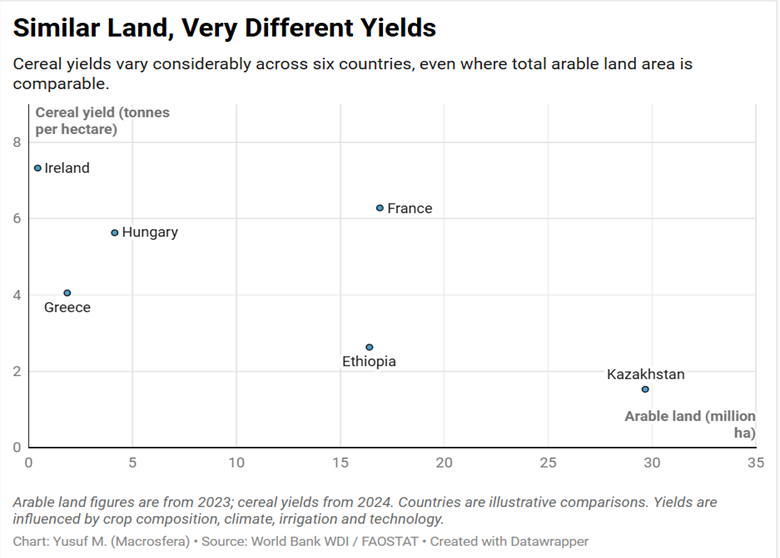
The differences become particularly interesting when agricultural yields are compared with the amount of arable land available. France and Ethiopia, for example, have almost identical areas of arable land, at around 16–17 million hectares each, yet France produces more than twice as much cereal per harvested hectare. Kazakhstan presents an even more striking contrast. Despite having nearly 30 million hectares of arable land, its average cereal yield is just 1.5 tonnes per hectare. Initially, these differences might suggest substantial opportunities for investment, but the reasons behind them are not always straightforward.
Kazakhstan is an interesting example of why geography matters. Much of its wheat is grown across the northern steppe, where relatively low rainfall and short growing seasons limit agricultural output. Better machinery, fertilisers and farming techniques could improve productivity, but they cannot entirely overcome climatic constraints. Water-saving technologies and improved irrigation could provide opportunities in suitable regions, although these also depend on water availability and the cost of infrastructure. Being landlocked presents an additional logistical challenge. Agricultural exporters depend on railways and transport routes through neighbouring countries, adding costs and potentially reducing the returns farmers receive. This does not directly explain the country's lower yields, but it matters when assessing whether investing in higher production would actually be profitable. In other words, a large amount of farmland does not necessarily translate into equally large opportunities for productivity growth.
For investors, the important question is how productive land could become in the future. In developed agricultural markets, land values may already reflect established infrastructure, strong market access and high productivity. In parts of emerging markets, there may be a greater gap between current and potential output. Closing that gap could increase the income generated by farms, potentially making the underlying land more valuable.
That distinction is important because low productivity does not necessarily mean land is undervalued. Building the infrastructure needed to improve productivity requires capital. Weak institutions, insecure land rights and political instability can prevent productivity gains from being realised or captured by investors. Ethiopia, for example, has considerable agricultural potential but also faces serious political and security challenges, including the conflict in Tigray and its broader tensions with Eritrea. The concept of convergence suggests a possible source of returns and productivity growth, but there is no guarantee that emerging-market farmland will outperform developed markets.
There is also a wider potential labour-market benefit to consider. Agriculture remains central to employment and rural incomes in many emerging economies. Improvements in productivity could support higher earnings, greater food availability and the development of surrounding industries, from storage and processing to logistics and agricultural services. Provided those gains are shared with local communities, investment in productive capacity could have implications well beyond the value of the land itself.
However, there is little benefit in producing considerably more food if farmers cannot reliably sell it or get it to the people who need it. This brings me to another development that I find interesting: the growing internationalisation of food production, and what might loosely be described as the offshoring of agriculture. Unlike manufacturing, where production can sometimes be relocated to take advantage of lower labour costs, agricultural production is ultimately tied to geography. Climate, water availability, soil and growing conditions all determine what can be produced and where. Countries with limited agricultural resources cannot simply manufacture more productive land within their borders. Instead, they have increasingly relied on production elsewhere, either through international food markets or investment in overseas agricultural businesses.
The scale of this relationship is already considerable. According to the OECD and FAO, the proportion of global agricultural production traded internationally increased from 16% in 2000 to approximately 22–23% today, although that share has remained broadly stable in recent years. Latin America and the Caribbean currently export around 44% of their agricultural production, measured in calories, while the Middle East and North Africa are projected to rely on imports for 72% of their consumption of the agricultural commodities covered by the Outlook by 2035. These differences partly reflect the geographical imbalance between where food can be produced efficiently and where demand is growing.
A 2024 review published in Nature Reviews Earth & Environment estimated that roughly 20% of the water used in global food production is effectively traded internationally through agricultural products. When a country imports wheat, rice or soybeans, it is therefore also depending on the land, water and other resources used to produce them beyond its own borders. This becomes particularly significant for economies where expanding domestic production is increasingly difficult because of water scarcity, limited farmland or unsuitable growing conditions.
Saudi Arabia provides an interesting example of how this dependence has begun translating into investment decisions. Through its Public Investment Fund-owned agricultural investment company, SALIC, the country has built an international portfolio spanning agricultural production, storage, trading and processing. Its investments have included approximately 200,000 hectares of agricultural land in Western Australia and a similar area in western Ukraine. More recently, in April 2026, SALIC completed a $1.88 billion transaction to increase its ownership of Olam Agri to 80.01%, gaining control of a business with agricultural sourcing, processing and logistics operations across more than 30 countries. This represents something rather different from simply purchasing grain on international markets. It reflects a strategy of securing greater influence over the businesses and infrastructure that connect agricultural production with global food demand.
I think this has important implications for emerging markets. The OECD–FAO Outlook projects that middle-income countries will account for more than 80% of additional global agricultural production over the coming decade. While much of this growth will serve domestic consumers, it also points towards a changing geography of agricultural supply. Countries capable of improving productivity and connecting farmers to international markets may be able to capture a greater share of demand from food-importing economies.
For investors, the opportunity could come from different mechanisms. The first is the potential for productivity convergence, where improvements in irrigation, infrastructure and farming techniques increase the output and income generated by existing land. The second is the growing importance of reliable agricultural production, particularly where it can serve international markets facing their own constraints. If emerging-market farms become more productive while also gaining access to a larger customer base, their earning potential could improve considerably.
But how can investors actually gain exposure to agricultural land? For institutional investors, this is already an established asset class. Firms such as Nuveen Natural Capital and Manulife Investment Management manage agricultural land portfolios on behalf of large investors, acquiring productive farmland and generating returns through rental income, farming operations and potential land appreciation. These structures allow investors to diversify across crops and geographical regions, although they require considerable capital and specialist knowledge of agricultural markets. Similarly, pension funds and other institutions may be attracted to farmland because it offers exposure to a physical asset whose productive use could generate income over long periods.
For retail investors, the options are somewhat different and more limited. Listed farmland investment trusts, such as Farmland Partners and Gladstone Land, provide indirect exposure through shares in companies that own and lease agricultural land across the United States. There are also private farmland investment platforms and specialist funds, although many are restricted to wealthier or accredited investors. Importantly, these routes generally offer exposure to established agricultural markets rather than directly to the emerging-market productivity opportunities discussed throughout this article.
I think there is another approach worth considering, particularly for smaller investors interested in emerging economies. Instead of purchasing land outright, capital can be directed towards existing farmers, cooperatives and agricultural businesses that need financing to improve their operations.
The UK's Shared Interest, for example, allows individuals to invest from £100, pooling members' money to provide financing to fair-trade businesses, including agricultural cooperatives in developing countries. This is not direct ownership of agricultural land, nor does it offer the same potential returns from land appreciation. However, it demonstrates how relatively small amounts of capital can be channelled towards agricultural production without investors needing to purchase entire farms.
There is a social distinction here. Large-scale foreign investment can bring infrastructure, employment and access to international markets, but it can also create tensions over land ownership and give institutions far more influence in emerging-market countries. Smaller investments structured around existing producers may allow farmers to retain control of their land while obtaining the financing needed for irrigation, machinery or storage facilities.
The International Fund for Agricultural Development has emphasised that secure land rights are important in allowing rural communities to invest in their own productive capacity. To me, this raises an interesting possibility: agricultural investment does not always have to involve transferring land from local producers to outside owners. In some circumstances, helping existing farmers become more productive could offer a better outcome for rural communities while still providing a financial return to investors.
These approaches all carry different risks. I have not really made my case using detailed statistics on returns, and I have not fully considered currency or political risk, so there may be a part two to this piece but for now agricultural commodity prices remain volatile, land is relatively illiquid, and financing small agricultural businesses exposes investors to significant credit, operational and political risks in emerging markets. Investment through cooperatives or community-finance arrangements may offer lower financial returns and extremely limited opportunities to sell an investment quickly. Equally, smaller-scale financing is not automatically beneficial to local workers. Its success depends on fair financing terms, secure land rights and whether the resulting productivity gains actually translate into better incomes and working conditions.
To conclude, I think the combination of these developments makes agricultural land an increasingly interesting asset to examine. The world is expected to require more food, yet the resources needed to produce it are unevenly distributed and increasingly exposed to environmental and geopolitical pressures. Large differences in agricultural productivity also remain, creating opportunities for some economies to improve output through investment and technological adoption.